How to Be Holy: First Steps in Becoming a Saint by Peter Kreeft
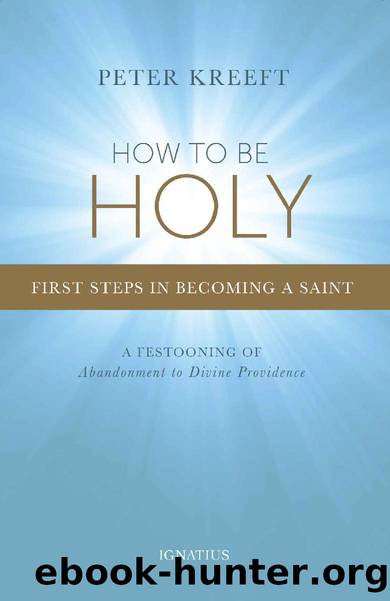
Author:Peter Kreeft [Kreeft, Peter]
Language: eng
Format: epub
Tags: Spiritual & Religion
ISBN: 9781681496924
Publisher: Ignatius Press
Published: 2016-02-11T06:00:00+00:00
16
Faith, Hope, and Love Are Only One Thing
De Caussade says: âThe state of self-abandonment is a blending of faith, hope and love in one single actâ (p. 60).
What does that look like?
Like the look a little baby gives to his Mommy or Daddy when looking up into a big, smiling face. Like the look a purring cat gives you when you stroke its fur. Like the look a dog gives you when it wags its tail. Thatâs why God invented cats and dogs: to teach us what faith, hope, and love look like. What do we see in that look? No judgment. No reasoning. No doubts. No thoughts. No worry about tomorrow. Just love. What kind of love? Faith-hope-love.
De Caussade says these three theological virtues are âblendedâ in one act. Itâs even stronger than that: they are not just held together; they become one simple act. You say Yes to God with your whole heart and, therefore, with all three powers of your heart, the intellect (faith) and the will (love) and the desires (hope).
The great philosopher Kant once said that the three greatest human questions are: What can I know? What should I do? and What may I hope? The three theological virtues are the Christian answer to these three questions. Faith tells us the essential truth about ourselves and our relation to God; and love tells us our essential moral task; and hope tells us that our fundamental desire, the desire not just for pleasure or even for happiness, but for joy, will be fulfilled.
Although faith is primarily in the intellect, and love in the will, and hope in the feelings or emotions, yet each of these three theological virtues, faith and hope and love, has an intellectual and a volitional and an emotional component.
The intellectual component of faith is belief. Its volitional component is âthe will to believeâ. The choice to believe combines the mindâs belief and the willâs command. The emotional component of faith is confidence. This can be both a cause and an effect of faith in the mind and will.
The essence of faith is trust. Trust is not merely emotional. Your bank is a âtrust companyâ because you entrust your money to it, but you donât need to feel warm fuzzies toward your bank for it to work.
The first sin, in Eden, was unbelief in the sense of lack of trust. The Devil told Eve that God was not to be trusted. That mistrust led to every other sin.
Godâs remedy for our mistrust is His infinite and all-powerful mercy, which is stronger than all our sins. Godâs mercy makes holiness easy because it makes our basic task not hard penances but joyful trust. Our joy (in the form of trust) brings down Godâs joy (in the form of mercy). Saint Faustina writes: âThe graces of My mercy are drawn by means of one vessel only, and that isâtrust. The more a soul trusts, the more it will receive.â
Hopeâs intellectual component is belief that God will fulfill all His promises.
Download
This site does not store any files on its server. We only index and link to content provided by other sites. Please contact the content providers to delete copyright contents if any and email us, we'll remove relevant links or contents immediately.
Machine Learning at Scale with H2O by Gregory Keys | David Whiting(4313)
Never by Ken Follett(3957)
Fairy Tale by Stephen King(3399)
Reminders of Him: A Novel by Colleen Hoover(3121)
The Man Who Died Twice by Richard Osman(3080)
Will by Will Smith(2920)
It Starts With Us (It Ends with Us #2) by Colleen Hoover(2367)
Rationality by Steven Pinker(2366)
Can't Hurt Me: Master Your Mind and Defy the Odds - Clean Edition by David Goggins(2342)
Friends, Lovers, and the Big Terrible Thing by Matthew Perry(2230)
The Becoming by Nora Roberts(2203)
The Stranger in the Lifeboat by Mitch Albom(2123)
Love on the Brain by Ali Hazelwood(2078)
New Morning Mercies: A Daily Gospel Devotional by Paul David Tripp(1920)
A Short History of War by Jeremy Black(1848)
HBR's 10 Must Reads 2022 by Harvard Business Review(1845)
The Strength In Our Scars by Bianca Sparacino(1844)
A Game of Thrones (The Illustrated Edition) by George R. R. Martin(1746)
Never Finished: Unshackle Your Mind and Win the War Within by David Goggins(1714)
